
SWIM MEET 101
Swim meets are a great family experience. They're a place where the whole family can spend time together.
Listed below are some in-depth guidelines to help you through your swim meets. It may seem a little overwhelming, but we tried to be as specific as possible. If you have any questions, please ask the coaches or experienced swimmers and parents.
Packing List for a Meet:
It is always good to prepare ahead of time for a meet. The weather in early summer varies and is often unpredictable so it’s good to check the forecast and pack accordingly. Some nights you may need a sweatshirt to stay warm while other nights you may need fans and ice packs to stay cool. Below are some suggested items to keep in your swim bag:
| Towels | Picnic Blanket | Heat Sheet (print at home if available) |
| Swim caps | Sunscreen | Water and/or sports drink |
| Healthy Snacks | Hat/visor | Lawn chairs for parents |
| Sharpies/highlighters | Games | Cash for concessions |
| Sweatshirt if temps are cool | Goggles (+ extra pair) | Something to help stay cool (ie fan, cold towel, ice pack, spray bottle) |
BEFORE the Meet begins:
1. Check your email after 3pm on meet days. The coach will send out heat sheets as soon as they are available. It is very helpful if you print out heat sheets before you come to the meet. Keep in mind that the coach cannot send out home meet heat sheets until the opposing team sends in their team's entries and cannot send out away meet heat sheets until they are sent to our team by the home team's coach.
2. Arrive at the pool at least 15 minutes before our team’s scheduled warm-up time. This time will be listed in the meet information on the website as well as in the team newsletters and emails.
3. Upon arrival, find a place to put your swimmer's blankets, towels, and/or swim bag. Our team will have a large area to sit together, and the younger swimmers (10 and under) should look for their age group helpers and sit together. The age group helpers will be wearing yellow vests and have a sign marking the area to sit. Parent volunteers will report to the volunteer coordinator table when they arrive at the pool.
4. Make sure your swimmer checks in with his or her age group helper.
5. Write (or have the swimmer write) each event number, heat number, and lane number on his or her arm with a Sharpie marker. This helps the swimmer and volunteers know when/where the swimmer should swim. It is also helpful to write the swimmer's first initial and last name on their shoulder blade. If this is not complete by warmups, the swimmer may do afterward. See example below.

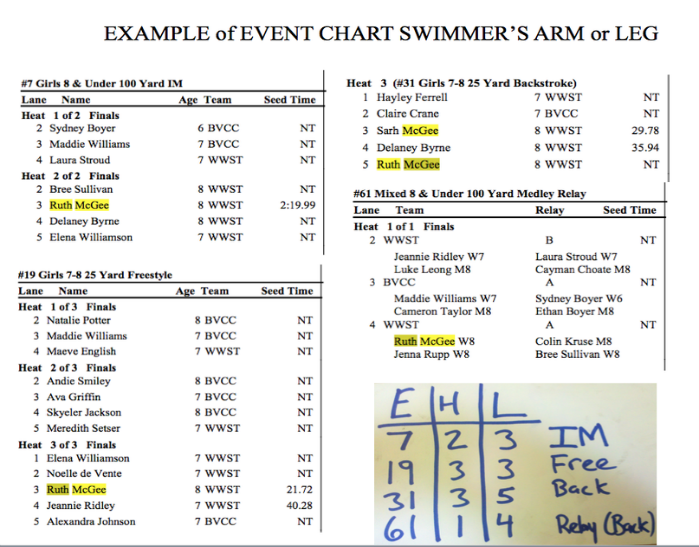
6. Your swimmer now gets his/her cap and goggles and reports to the pool and/or coach for warm-up instructions. It is very important for all swimmers to warm-up with the team.
7. After warm-ups, your swimmer will go back to the area where his/her age group is sitting and wait there until their first event is called. This is a good time to make sure he/she goes to the bathroom if necessary, gets a drink, or just gets settled in.
There will be lots of down time during the meet, so bring something for the swimmers to do!
DURING the Meet:
1. The meet will usually start about 10-15 minutes after warm-ups are over.
2. You can use the Heat Sheet to help you follow along with the events of the meet. The Heat Sheet lists all swimmers in each event in order of "seed time". When the team entry is sent in, each swimmer and his/her previous best time in that event is listed. If the swimmer is swimming an event for the first time, he/she will be entered as a "no-time" or "NT". A "no-time" swimmer will most likely swim in one of the first heats of the event. The times may also look different depending if the pool is meters or yards.
3. Volunteer Age Group Helpers will assist the younger swimmers (ages 10 and under) find their way to the blocks. It is NOT the responsibility of the Age Group Helpers to track down your swimmer. The parent/guardian of each swimmer is responsible for making sure their child goes to the Age Group Helpers at the designated location when the announcer announces "first call" for each of the swimmer's events. It greatly benefits the swimmers to sit with their age group peers.
4. The swimmer swims his or her race. There are 5 different events the swimmers can be entered into: Freestyle, Backstroke, Butterfly, Breaststroke and Individual Medley (FLY, BACK, BREAST, FREE) and 2 different types of relays: Medley Relay (BACK, BREAST, FLY, FREE) and Freestyle Relays. Most swimmers will compete in a stroke the coach thinks will be successful for the swimmer. It is very important to the coaches to build the confidence of their swimmers.
5. Keep in mind the time for various events can differ greatly, for instance: 200 Freestyle might take a few minutes whereas a 25 Freestyle might take 30 seconds.
6. There are two types of swims: Regulation and Exhibition. Regulation will score points for the team. There are 3 swimmers from our team and 3 swimmers from the opposing team. They will battle it out for first, second, and third place. The exhibition swimmers will swim for a time only. Every exhibition swimmer will receive a ribbon.
7. You will see “officials” on the pool deck to make sure we are following USA Swimming rules and that our swimmers are competing with legal strokes.
8. All questions concerning meet results, an officiating call, or the conduct of a meet, should be referred to a coach. He or she, in turn, will pursue the matter through the proper channels.
AFTER your swimmer swims an event:
1. This swimmer can ask the timers (people behind the blocks at the end of each lane) his/her time.
2. The swimmer should then go immediately to his/her coach to discuss and get feedback about their swim. The coaching staff will be sure to discuss stroke technique with the swimmer. Parents/family need to tell the swimmer how proud they are and what a great job they did.
3. The swimmer will then go back to the team area and relax, go to the bathroom, get a drink or something light to eat. It is very important that swimmers stay hydrated during the meet.
4. The swimmer now waits until his next event is called and starts the procedure again.
5. When a swimmer has completed all of his/her events, you may leave. However, DO NOT leave without checking in with the coach. Even if your swimmer was not initially placed on a relay team, sometimes they may end up swimming a relay at the end of the night due to absences.
6. Please make sure that you are respectful of the facility and clean up after yourself.
7. Results are usually posted on the website. Ribbons are gathered for a team and given to the coach at the end of the meet. The ribbons will be filed in each family's team file folder within one week of the meet.